

Is Carbonated Water A Solution
Carbonated water (also known as soda water, sparkling water, fizzy water, social club soda, water with gas, in many places equally mineral water, or specially in the United States every bit seltzer or seltzer water) is water containing dissolved carbon dioxide gas, either artificially injected under pressure or occurring due to natural geological processes. Carbonation causes small bubbles to form, giving the water an effervescent quality. Common forms include sparkling natural mineral water, club soda, and commercially-produced sparkling water.[i]

Sparkling water showing its carbonation, which may exist either natural or artificially introduced
| External audio | |
|---|---|
 "Fizzy Water", Distillations Podcast Episode 217, Science History Institute "Fizzy Water", Distillations Podcast Episode 217, Science History Institute |
Social club soda and sparkling mineral h2o and another sparkling waters incorporate added or dissolved minerals such as potassium bicarbonate, sodium bicarbonate, sodium citrate, or potassium sulfate. These occur naturally in some mineral waters merely are too commonly added artificially to manufactured waters to mimic a natural flavor profile and offset the acerbity of introducing carbon dioxide gas. Various carbonated waters are sold in bottles and cans, with some also produced on demand by commercial carbonation systems in confined and restaurants, or made at dwelling house using a carbon dioxide cartridge.[2]
It is idea that the beginning person to aerate water with carbon dioxide was William Brownrigg in 1740.[3] Joseph Priestley invented carbonated water, independently and past accident, in 1767 when he discovered a method of infusing water with carbon dioxide later on having suspended a basin of h2o above a beer vat at a brewery in Leeds, England.[4] He wrote of the "peculiar satisfaction" he found in drinking it, and in 1772 he published a newspaper entitled Impregnating H2o with Fixed Air.[5] [six] Priestley'southward apparatus, almost identical to that used by Henry Cavendish five years earlier, which featured a bladder betwixt the generator and the assimilation tank to regulate the flow of carbon dioxide, was soon joined by a broad range of others. Still, information technology was not until 1781 that carbonated water began being produced on a big scale with the establishment of companies specialized in producing artificial mineral water.[iv] The starting time factory was built past Thomas Henry of Manchester, England.[iv] Henry replaced the bladder in Priestley's system with big bellows.[4]
While Priestley's discovery ultimately led to the cosmos of the soft beverage industry—which began in 1783 when Johann Jacob Schweppe founded Schweppes to sell bottled soda water,[7] he did non do good financially from his invention.[4] Priestley did however receive scientific recognition when the Council of the Royal Society "were moved to reward its discoverer with the Copley Medal" in 1772.[4] [8]
Composition [edit]
Natural and manufactured carbonated waters may contain a pocket-sized amount of sodium chloride, sodium citrate, sodium bicarbonate, potassium bicarbonate, potassium citrate, potassium sulfate, or disodium phosphate, depending on the product. These occur naturally in mineral waters but are added artificially to commercially produced waters to mimic a natural flavor profile and offset the acidity of introducing carbon dioxide gas (which creates depression five-six pH carbonic acid solution when dissolved in water).[9]
Artesian wells in such places as Mihalkovo in the Bulgarian Rhodope Mountains, Medžitlija in N Macedonia, and most notably in Selters in the German Taunus mountains, produce naturally effervescent mineral waters.[x]
Wellness furnishings [edit]
By itself, carbonated water appears to take lilliputian affect on health.[11]
Carbonated water such as society soda or sparkling h2o is defined in Usa law equally a food of minimal nutritional value, even if minerals, vitamins, or artificial sweeteners take been added to it.[12]
Carbonated water does not announced to have an effect on gastroesophageal reflux disease.[xiii] In that location is tentative evidence that carbonated water may help with constipation amid people who accept had a stroke.[14]
Acid erosion [edit]
While carbonated water is somewhat acidic, this acidity can exist partially neutralized by saliva.[fifteen] A study found that sparkling mineral water is slightly more erosive to teeth than non-carbonated water just is about 1% as corrosive as soft drinks are. A 2017 study by the American Dental Association showed that it would take over 100 years of daily sparkling water consumption to crusade damage to human teeth - a claim that could not apply if at that place is added sugar or artificial flavorings, which often include citric acid and other fruit acids, predicted to have an touch on on human teeth.[xvi]
Chemistry [edit]
Bonds in carbonic acid are more easily broken at high temperatures resulting in the generation of h2o and gaseous carbon dioxide. Thus sparkling water at lower temperatures (far right) holds more carbonation than at loftier (far left).[17]
Carbon dioxide gas dissolved in water at a low concentration (0.two–1.0%) creates carbonic acid (H2CO3)[eighteen] according to the following reaction:
- H
2 O (l) + CO
2 (yard) ⇌ H
2 CO
3 (aq)
The acid gives carbonated water a slightly tart season. The pH level betwixt 5 and 6 [9] is approximately in between apple juice and orangish juice in acerbity, only much less acidic than the acid in the stomach. A normal, healthy homo body maintains pH equilibrium via acid–base homeostasis and will not exist materially adversely affected by consumption of plainly carbonated water.[xix] Alkaline metal salts, such every bit sodium bicarbonate, potassium bicarbonate, or potassium citrate, will increase pH.
The amount of a gas that tin can be dissolved in h2o is described past Henry's Law. In the carbonization process, water is chilled, optimally to just above freezing, to maximize the amount of carbon dioxide that can be dissolved in it. Higher gas pressure and lower temperature cause more than gas to deliquesce in the liquid. When the temperature is raised or the pressure is reduced (equally happens when a container of carbonated water is opened), carbon dioxide effervesces, thereby escaping from the solution.
History [edit]

Many alcoholic drinks, such every bit beer, champagne, cider, and spritzer, were naturally carbonated through the fermentation process for centuries. In 1662 Christopher Merret created 'sparkling vino'.[20] William Brownrigg was apparently the offset to produce artificial carbonated h2o, in the early 1740s, by using carbon dioxide taken from mines.[21] In 1750 the Frenchman Gabriel François Venel also produced bogus carbonated h2o, though he misunderstood the nature of the gas that caused the carbonation.[22] In 1764, Irish pharmacist Dr. Macbride infused water with carbon dioxide as part of a serial of experiments on fermentation and putrefaction.[23] [24] In 1766 Henry Cavendish devised an aerating apparatus that would inspire Joseph Priestley to carry out his own experiments with regards to carbonated waters.[25] Cavendish was also enlightened of Brownrigg'southward observations at this time and published a paper on his own experiments on a nearby source of mineral h2o at the beginning of January in the next year.[26]

Equipment used by Priestley in his experiments on gases and the carbonation of h2o
In 1767 Priestley discovered a method of infusing water with carbon dioxide by pouring water back and along to a higher place a beer vat at a local brewery in Leeds, England.[27] [28] [29] The air blanketing the fermenting beer—called 'fixed air'—was known to impale mice suspended in it. Priestley found water thus treated had a pleasant taste, and he offered it to friends equally a absurd, refreshing potable. In 1772, Priestley published a paper titled Impregnating H2o with Fixed Air in which he describes dripping "oil of vitriol" (sulfuric acid) onto chalk to produce carbon dioxide gas, and encouraging the gas to deliquesce into an agitated bowl of water.[5] Priestley referred to his invention of this treated h2o every bit being his "happiest" discovery.[28]
"Within a decade, inventors in Britain and in Europe had taken Priestley's bones idea—get some "fixed air," mix it with water, shake—and created contraptions that could make carbonated water more quickly, in greater quantities. One of those inventors was named Johann Jacob Schweppe, who sold bottled soda h2o and whose business organization is still effectually today."
—The Great Soda-Water Milk shake Up, The Atlantic, October 2014.[thirty]
Priestley's apparatus, which was very like to that invented by Henry Cavendish five years earlier, featured a float between the generator and the absorption tank to regulate the flow of carbon dioxide, and was soon joined by a wide range of others, just it was not until 1781 that carbonated water began being produced on a large calibration with the establishment of companies specialized in producing artificial mineral water.[iv] The first factory was built by Thomas Henry of Manchester, England.[iv] Henry replaced the bladder in Priestley'southward organisation with large bellows.[4] J. J. Schweppe developed a process to manufacture bottled carbonated mineral water based on the discovery of Priestley, founding the Schweppes Company in Geneva in 1783. Schweppes regarded Priestley as "the father of our industry".[31] In 1792 he moved to London to develop the business there. In 1799 Augustine Thwaites founded Thwaites' Soda Water in Dublin. A London Earth article claims that this company was the first to patent and sell "Soda Water" under that proper name. The commodity says that in the hot summer of 1777 in London "aerated waters" (that is, carbonated) were selling well but there was as nevertheless no mention of "soda water", though the offset effervescent drinks were probably made using "soda powders" containing bicarbonate of soda and tartaric acid.[32] The name soda water arose from the fact that soda (sodium carbonate or bicarbonate) was often added to adjust the taste and pH.[ citation needed ]
Mod carbonated water is fabricated by injecting pressurized carbon dioxide into water.[33] The force per unit area increases the solubility and allows more carbon dioxide to dissolve than would be possible under standard atmospheric pressure. When the bottle is opened, the pressure is released, allowing gas to go out the solution, forming the characteristic bubbles.
Etymology [edit]
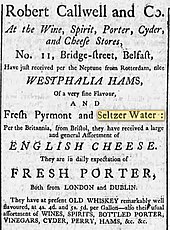
Belfast Evening Post, Belfast, Republic of ireland, Baronial 7, 1786
In the United States, obviously carbonated water was generally known either as soda h2o, due to the sodium salts it contained, or seltzer water, deriving from the German language town Selters renowned for its mineral springs.[34]
Sodium salts were added to plain h2o both equally flavoring (to mimic famed mineral waters, such equally naturally effervescent Selters, Vichy water and Saratoga water) and acerbity regulators (to offset the acidic 5-vi pH carbonic acid created when carbon dioxide is dissolved in water).[nine]
In the 1950s the term order soda began to be popularized.[35]
In the 1970s marketing-driven terms such as sparkling h2o gained favor, with an explosion of consumption of the naturally carbonated Perrier water[ citation needed ].
Mostly, seltzer water has no added sodium salts, while club soda still retains some sodium salts.[35]
Products for carbonating water [edit]
Dwelling [edit]
Soda siphons [edit]

The soda siphon, or seltzer bottle—a glass or metallic pressure vessel with a release valve and spout for dispensing pressurized soda water—was a mutual sight in bars and in early- to mid-20th-century homes where information technology became a symbol of middle-class abundance.
The gas force per unit area in a siphon drives soda water up through a tube inside the siphon when a valve lever at the top is depressed. Commercial soda siphons came pre-charged with h2o and gas and were returned to the retailer for commutation when empty. A deposit scheme ensured they were not otherwise thrown abroad.
Home soda siphons can carbonate flatwater through the use of a small disposable steel bulb containing carbon dioxide. The bulb is pressed into the valve associates at the top of the siphon, the gas injected, then the seedling withdrawn. Soda water made in this style tends not to be as carbonated as commercial soda water because h2o from the refrigerator is not chilled as much as possible, and the pressure of carbon dioxide is limited to that bachelor from the cartridge rather than the high-pressure pumps in a commercial carbonation plant.
Gasogene [edit]

Late Victorian seltzogene made by British Syphon
The gasogene (or gazogene, or seltzogene) is a late Victorian device for producing carbonated water. Information technology consists of ii linked drinking glass globes: the lower contained h2o or other drink to be made sparkling, the upper a mixture of tartaric acid and sodium bicarbonate that reacts to produce carbon dioxide. The produced gas pushes the liquid in the lower container up a tube and out of the device. The globes are surrounded past a wicker or wire protective mesh, as they accept a tendency to explode.[36]
Codd-neck bottles [edit]

The Codd-neck bottle is designed to comprise a marble which seals in the carbonation
In 1872, soft beverage maker Hiram Codd of Camberwell, London, designed and patented the Codd-neck canteen, designed specifically for carbonated drinks. The Codd-neck bottle encloses a marble and a rubber washer/gasket in the neck. The bottles were filled upside downwards, and pressure of the gas in the bottle forced the marble against the washer, sealing in the carbonation. The bottle was pinched into a special shape to provide a chamber into which the marble was pushed to open the bottle. This prevented the marble from blocking the neck equally the drink was poured.
Before long after its introduction, the bottle became extremely popular with the soft drinkable and brewing industries mainly in the United kingdom and the rest of Europe, Asia, and Australasia, though some alcohol drinkers disdained the utilise of the bottle. R. White's, the biggest soft drinks company in London and s-east England when the bottle was introduced, was among the companies that sold their drinks in Codd'due south glass bottles.[37] I etymology of the term codswallop originates from beer sold in Codd bottles, though this is generally dismissed equally a folk etymology.[38]
The bottles were produced for many decades, but gradually declined in usage. Since children smashed the bottles to retrieve the marbles, vintage bottles are relatively rare and have become collector items, peculiarly in the UK. Due to the take a chance of explosion and injuries from fragmented drinking glass pieces, utilize of this type of bottle is discouraged in nearly countries. The Codd-neck blueprint is still used for the Japanese soft drink Ramune and in the Indian drink called Banta.
Soda makers [edit]

A typical all-in-one soda maker for domicile utilise institute in supermarkets. A refillable carbon dioxide canister and a high-force per unit area bottle are oft included.
Soda makers or soda carbonators, known as countertop carborators,[39] are appliances that carbonate water with multiple-apply carbon dioxide canisters. Soda makers may reach a higher level of carbonation than home soda siphons.[ commendation needed ] A diversity of systems are produced past manufacturers and hobbyists.[40] [41] The commercial units may exist sold with full-bodied syrup for making flavored soft drinks.
1 major producer of soda carbonators is SodaStream. Their products were popular during the 1970s and 1980s in the United Kingdom, and are associated with nostalgia for that period and have experienced a comeback in the 2000s.[42] [43]
Commercial [edit]

The process of dissolving carbon dioxide in water is called carbonation. Commercial soda water in siphons is made by chilling filtered plain water to 8 °C (46 °F) or beneath, optionally adding a sodium or potassium based alkaline chemical compound such equally sodium bicarbonate to neutralize the acid created when pressurizing the water with carbon dioxide (which creates loftier eight-10 pH carbonic acid-bicarbonate buffer solution when dissolved in water).[44] The gas dissolves in the h2o, and a top-off fill of carbon dioxide is added to pressurize the siphon to approximately 120 pounds per square inch (830 kPa), some 30 to 40 psi (210–280 kPa) college than is nowadays in fermenting champagne bottles.[ citation needed ]
In many modernistic restaurants and bars soda h2o is manufactured on-site using devices known equally carbonators. Carbonators utilise mechanical pumps to pump water into a pressurized bedroom where it is combined with carbon dioxide from pressurized tanks at approximately 100 psi (690 kPa). The pressurized carbonated water then flows either directly to taps or mixing heads where flavoring is added before dispensing.
Uses [edit]
Carbonated beverages [edit]
Carbonated water is a key ingredient in soft drinks, beverages that typically consist of carbonated water, a sweetener, and a flavoring such as cola, ginger, or citrus.
Obviously carbonated water or sparkling mineral water is often consumed as an alternative to soft drinks. Gild soda is carbonated water to which compounds such as sodium bicarbonate or potassium sulfate have been added.[45] Many manufacturers produce unsweetened sparkling h2o products that are lightly flavored by the add-on of aromatic ingredients such as essential oils.[46] [47] Carbonated water is frequently mixed with fruit juice to make sparkling alcoholic and non-alcoholic punches.[48]
Alcoholic beverages [edit]
Carbonated water is a diluent mixed with alcoholic beverages where information technology is used to top-off the potable and provides a caste of 'fizz'.
Adding soda water to 'short' drinks such as spirits dilutes them and makes them 'long' not to be dislocated with long drinks such as those fabricated with vermouth. Carbonated water also works well in short drinks fabricated with whiskey, brandy, and Campari. Soda water may exist used to dilute drinks based on cordials such as orange squash. Soda h2o is a necessary ingredient in many cocktails, such as whiskey and soda or Campari and soda.[ citation needed ]
Cooking [edit]
Carbonated h2o is increasingly popular in Western cooking equally a commutation for plain water in deep-frying batters to provide a lighter texture to doughs similar to tempura. Kevin Ryan, a food scientist at the Academy of Illinois at Urbana–Champaign, says the effervescent bubbles when mixed with dough provide a light tempura-like texture, which gives the illusion of beingness lower calorie than regular frying batters. The lightness is caused past pockets of carbon dioxide gas being introduced into the batter (a process which natural rising using yeast also creates) and further expanding when cooked.[49]
Stain remover [edit]
Since the dissolved gas in carbonated h2o acts as a temporary surfactant, it has been recommended as a household remedy for removing stains, especially those of cherry-red wine.[50]
See also [edit]
- Premix and postmix
- Soda jerk
- Sodium carbonate
- Tonic water
- Limnic eruption – in deep water lakes, a massive, sudden eruption of dissolved carbon dioxide
References [edit]
- ^ Twilley, Nicola; Graber, Cynthia (13 December 2016). "The Medical Origins of Seltzer". The Atlantic . Retrieved 24 May 2019.
- ^ Jessica Krefting, MS, RD, LDN (September one, 2018). "Seltzer or Sparkling Water: An Culling to Flat Water". Journal of Renal Nutrition. 28 (5): E33–E35. doi:10.1053/j.jrn.2018.07.001. S2CID 81383075.
{{cite journal}}: CS1 maint: multiple names: authors list (link) - ^ Homan, Peter Gerald (22 September 2007). "Aerial Acid: A short history of bogus mineral waters" (PDF).
- ^ a b c d e f k h i Schils, René (2011). How James Watt Invented the Copier: Forgotten Inventions of Our Bully Scientists. Springer Scientific discipline & Business Media. p. 36.
- ^ a b Joseph Priestley. "DIRECTIONS FOR IMPREGNATING WATER WITH FIXED AIR; In order to communicate to it the peculiar Spirit and Virtues of Pyrmont Water, And other Mineral WAters of a ſimilar Nature". Today in Science. Archived from the original on 29 July 2019.
- ^ "Our fizzy seas of soda water". The Telegraph. 21 September 2016. Archived from the original on 2022-01-12.
- ^ "Schweppes Holdings Limited". Royalwarrant.org . Retrieved 13 October 2021.
Schweppes was founded in 1783 [..] the globe's first ever soft drink, Schweppes soda water, was born.
- ^ McKie, Douglas (18 July 2013). "Joseph Priestley and The Copley Medal". Ambix. 9: one–22. doi:10.1179/amb.1961.9.1.1.
- ^ a b c Reddy, Avanija; Norris, Don F.; Momeni, Stephanie S.; Waldo, Belinda; Red, John D. (April 2016). "The pH of beverages in the United States" (PDF). The Periodical of the American Dental Clan. 147 (4): 255–263. doi:x.1016/j.adaj.2015.x.019. PMC4808596. PMID 26653863.
- ^ "Powerful Effervescence". Summer 2008. Retrieved 2019-02-xiii .
- ^ Transmission of Dietetic Practice (five ed.). John Wiley & Sons. 2014. p. 998. ISBN9781118760574 . Retrieved 19 June 2016.
- ^ "Foods of Minimal Nutritional Value". fns.usda.gov. Appendix B of seven CFR Role 210. Nutrient and Diet Service, United states Department of Agriculture. 13 September 2013. Retrieved 2017-08-04 .
- ^ Johnson, T; Gerson, L; Hershcovici, T; Stave, C; Fass, R (March 2010). "Systematic review: the furnishings of carbonated beverages on gastro-oesophageal reflux disease". Alimentary Pharmacology & Therapeutics. 31 (half dozen): 607–xiv. doi:10.1111/j.1365-2036.2010.04232.10. PMID 20055784. S2CID 41920043.
- ^ Coggrave, Thou; Norton, C; Cody, JD (13 January 2014). "Management of faecal incontinence and constipation in adults with central neurological diseases". The Cochrane Database of Systematic Reviews (i): CD002115. doi:ten.1002/14651858.CD002115.pub5. PMID 24420006.
- ^ Ireland, Robert South., ed. (2010). Avant-garde dental nursing (second ed.). Chichester, U.K.: Wiley-Blackwell. p. 58. ISBN9781405192675 . Retrieved 19 June 2016.
- ^ Parry J, Shaw L, Arnaud MJ, Smith AJ (Baronial 2001). "Investigation of mineral waters and soft drinks in relation to dental erosion". J Oral Rehabil. 28 (eight): 766–72. doi:10.1046/j.1365-2842.2001.00795.x. PMID 11556958.
- ^ Field, Simon Quellen (2012). Culinary Reactions. Chicago, IL: Chicago Review Printing. pp. 99–100. ISBN978-one-56976-706-1.
- ^ "Carbon Dioxide in Water Equilibrium, Folio 1". Retrieved 2010-07-23 .
- ^ "Can I drinkable carbonated water? - CNN.com". Retrieved xv March 2016.
- ^ T. Stevenson, ed. The Sotheby's Wine Encyclopedia (quaternary Edition) pg 169–178 Dorling Kindersley 2005 ISBN 0-7513-3740-iv
- ^ Boantza, V. D.; Tomory, Fifty. (2016-eleven-15). "The "Subtile Aereal Spirit of Fountains": Mineral Waters and the History of Pneumatic Chemistry » Brill Online". Early Science and Medicine. 21 (4): 303–331. doi:10.1163/15733823-00214p02. PMID 29944255.
- ^ Funderburg, Anne Cooper (1995). Chocolate, Strawberry, and Vanilla. ISBN9780879726928 . Retrieved xv March 2016.
- ^ Funderburg, Anne Cooper (2002). "Experimental+Essays+on+Fermentation+of"&pg=PA6 Sundae Best: A History of Soda Fountains. ISBN9780879728540.
- ^ "The London Medical and Concrete Journal - Google Books". 1801. Retrieved 2018-01-03 .
- ^ Homan, Peter Gerald. "Aerial ACID: a short history of artificial mineral waters" (PDF). idus.usa.es . Retrieved May 8, 2017.
- ^ "11. Experiments on Rathbone-place water". Philosophical Transactions of the Royal Society of London. Rstl.royalsocietypublishing.org. 57: 92–108. 1767. doi:10.1098/rstl.1767.0012. S2CID 186214874. Retrieved 2018-01-03 .
- ^ "Joseph Priestley — Discovery of Oxygen — Invention of Soda H2o by Joseph Priestley". Inventors.about.com. 2009-09-16. Retrieved 2009-09-23 .
- ^ a b Stephen T Johnson (2009). The Invention of Air: An experiment, a journey, a new country and the amazing force of scientific discovery. ISBN978-1594488528.
- ^ "The Homo Who Discovered Oxygen and Gave the World Soda Water". New York Times. Retrieved 10 Jan 2015
- ^ "The Great Soda-Water Shake Up". The Atlantic . Retrieved thirteen October 2021.
- ^ LaMoreaux, Philip East. (2012). Springs and Bottled Waters of the World: Ancient History, Source, Occurrence, Quality and Use. Springer Scientific discipline & Business concern Media. p. 135.
- ^ "Invention of Soda Water". St. John Daily Sun. London Earth. 4 January 1904. Retrieved 2 September 2013.
- ^ "Is sparkling water really bad for yous?". BBC. BBC. fourteen September 2015. Retrieved 14 September 2015.
- ^ "Definition of seltzer — Merriam-Webster Online Lexicon". Retrieved 2007-11-07 .
- ^ a b Carbon h2o, January 29, 2011, retrieved June thirty, 2022
- ^ "Mixing information technology upwardly: A Look at the Evolution of the Siphon-Bottle". Archived from the original on 2018-08-22. Retrieved 2014-06-09 .
- ^ ""Hole-and-corner lemonade drinker": the story of R White'due south and successors in Barking and Essex". Barking and Commune Historical Gild. Retrieved nineteen October 2021.
- ^ Phrase Finder is copyright Gary Martin, 1996-2016. All rights reserved. "A load of codswallop". Archived from the original on 13 September 2008. Retrieved xv March 2016.
- ^ Meredith Paige Heil (December 12, 2020). "Make A DIY Seltzerator". The New York Times . Retrieved June 30, 2022.
- ^ "Making Carbonated Mineral H2o". Milwaukee Makerspace. 2011-09-26.
- ^ "Home Carbonation System". Instructibles. 2007-07-fifteen.
- ^ "Sodastream". Waitrose Food Illustrated. Waitrose. 12 September 2006. Archived from the original on 12 September 2006. Retrieved 12 September 2006.
- ^ David Smith (18 June 2006). "Wham! Big pilus and Eighties pop make internet comeback". The Observer . Retrieved 12 September 2006.
- ^ Carbonic acrid, britannica.com
- ^ Funston, Lindsay (Apr 27, 2018). "What Is Seltzer - Is Seltzer Bad For You". Delish . Retrieved August 1, 2021.
- ^ Chaussee, Jennifer (2016-12-15). "The Mysterious Allure of LaCroix's 'Natural Flavour'". Wired.
- ^ "Why is LaCroix defending itself on Twitter?". 2018-10-04.
- ^ "Nigh Flavored Sparkling Water with No Calories".
- ^ Rentschler, Kay. "Sparkling water lightens foods". Chicago Tribune. Chicago Tribune. Retrieved 27 December 2014.
- ^ Wishnok, Pete. "How does society soda remove red vino stains?". Scientific American . Retrieved 15 Apr 2016.
External links [edit]

- The Priestley Society
- Priestley's paper Impregnating Water with Stock-still Air 1772
- Interview with ane of New York Metropolis's last seltzer delivery men

Is Carbonated Water A Solution,
Source: https://en.wikipedia.org/wiki/Carbonated_water
Posted by: schellertocke1967.blogspot.com
0 Response to "Is Carbonated Water A Solution"
Post a Comment