

During Activities Requiring Aerobic Endurance
The mostly accepted model of energy systems has been used for many years. When practise intensity rises and glucose uptake by working muscles is increased, a drib in circulating glucose is observed while in college intensity exercise, muscle glucose uptake can increase past every bit much as 30 - l times, compared to the resting rate. Changes is glucose metabolism have been described past numerous authors and forms an integral part of the modification of energy systems to training stimulus. This is integral to understanding the changes that may occur in the use of blood borne glucose and intra muscular glycogen that may be a mark of practice intensity. Further Increased cytosolic and more effectively mitochondrial calcium during high ATP turnover in exercise increases glucose phosphorylation while in some cells MAS converted lactate to pyruvate whereas glucose oxidation and lactate product are influenced by the activity of MAS when the intensity of practise rises, information technology can pb to down-regulation of MAS activity, which leads to an increase in lactate production Where MAS is inhibited, at that place is a 50% decrease in lactate oxidation. Likely sites for the accommodation of MAS are highlighted and the effect that this can have on our view of how the energy systems office during high intensity exercise are also suggested. Through consideration of these metabolic events a new vision of energy system function is proposed.
Keywords: Energy systems; Sports; Lactate arrangement
For many years the notion of the aerobic and anaerobic systems has been used to define the type of work being carried out by athletes during high intensity sports. The traditional view is that the resynthesis of ATP is supplied by three integrated systems comprising the Creatine Phosphate (PCr), lactic and aerobic systems.1 This now appears to have been wrong.2 The three-system model does not explain why certain timelines of operation seem to exist in the aerobic area of metabolism. The balance of how each of these systems contributes at different times has been reviewed by a number of authors. As the anaerobic contribution declines, the aerobic increases with continued activity duration.3,4 Larsen (2010) referred to the first and 2d ventilatory thresholds, which in other papers have been divers every bit the aerobic threshold, lactate threshold, max-lass, anaerobic threshold and onset of Blood Lactate Accumulation (OBLA).5-7 These points have been seen as important in determining the transition from the predominance of the aerobic system to the "lactate organization." This definition is incorrect however, as the thresholds speak more about the human relationship between clearance rates and lactate production than lactate production lonely. The literature is littered with defoliation equally to where each occurs and what it ways, generally due to the mix of protocolsviii and subjects used (elite athletes, middle-aged sedentary, college students etc). The outcome of this was to create confusion as to what went on, where and why. Although some activities may rely predominately on a unmarried arrangement (either very short or very long elapsing activities, where the per centum contribution from of the other systems is small), the timing and intensity of other activities crave a significant contribution of more than than 1 free energy transfer system. All activities actuate each energy system to some degree, depending on practice intensity and duration.
During maximal efforts, the anaerobic (lactic) system lasts from 45 seconds to 2 minutes, after which all further exercise would be aerobic.9 In adults, maximal exercise of 60-120 sec duration has resulted in attainment or near attainment of VO2max.10-13 This illustrates that, if the intensity is high enough, there may be a significant contribution from the aerobic system and it may exist possible to reach Top Oxygen Uptake (PVO2,) in what are considered "anaerobic tests".xi As displayed in Effigy 1,14 the anaerobic reactions of glycolysis (short-term free energy transfer arrangement) generate increasingly greater energy for ATP resynthesis when all-out exercise continues longer than a few seconds. An increment occurs in aerobic energy contribution very early in exercise only climbs at a slower charge per unit than the anaerobic system delivery charge per unit.xv Despite this, the energy requirement of all-out exercise significantly exceeds the free energy generated past hydrogen's oxidation in the respiratory chain. This ways that the anaerobic reactions of glycolysis predominate, with large quantities of lactic acrid accumulating within the active muscle and ultimately appearing in the blood.

Figure 1 Shows the traditional model illustrating the involvement of anaerobic and aerobic energy transfer systems for different durations of all-out exercise.14
Unlike tests for maximal oxygen uptake, no specific criteria exist to indicate that a person has reached a maximal anaerobic effort. Although motivation and the test environment likely influence the exam score, researchers most commonly use the level of blood lactate to betoken the degree of activation of the brusque-term free energy organisation. Activities requiring substantial activation of the short-term energy system demand maximal piece of work for upward to iii minutes. All-out runs and cycling exercise have usually been used, although weight lifting of a sure percentage of maximum and shuttle runs are also used.16,17 Because age, sex, skill, motivation and body size touch maximal operation, selecting a suitable benchmark examination for developing standards for glycolytic energy capacity is hard.
Figure 218 presents the percentage contribution of each metabolic pathway during 3 dissimilar all-out cycle ergometer tests. The results are shown equally a percentage of the total piece of work output. Note the progressive change in the percentage contribution of each of the energy systems to the total work output as duration increases. Persons who engage in sports that require sustained, loftier-intensity practice (i.east. endurance) generally possess a large aerobic energy transfer capacity. Men and women who compete in distance running, swimming, bicycling and cross-country skiing by and large record the highest maximal oxygen uptakes. These athletes have about twice the aerobic capacity of sedentary individuals. This does not mean that VO2max lone determines endurance exercise capacity. Other factors, particularly those at the musculus level such as capillary density, enzymes and fibre type, strongly influence the capacity to sustain a high per centum of VO2 max. All the same, the VOii max does provide useful information about the capacity of the long-term energy system. For case, attainment of VO2 max requires integration of ventilatory, cardiovascular and neuromuscular systems; this gives meaning physiologic "pregnant" to this metabolic measure. For these reasons, VO2 max represents a central measure in practice physiology and oftentimes serves every bit the standard against which to compare performance estimates of aerobic capacity and endurance fitness. Because it is the aim of training to induce an adaptive response that is both useful to the overall development of an athlete and that volition ultimately transfer to better performance, it is crucial to empathise both the adaptive mechanisms that cause the benefits and the intensity and elapsing of activity to optimally stimulate these. The intensity at which these grooming induced modifications take place is notwithstanding open to much conjecture in science, or the proverbial "thumb suck" or art of coaching.
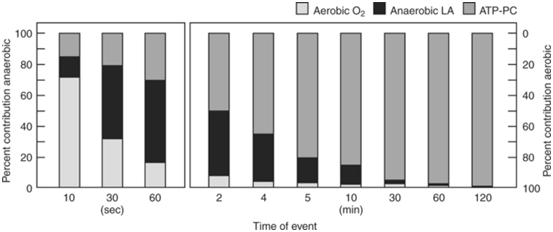
Figure ii Fourth dimension energy system continuum. Approximate relative contributions of aerobic and anaerobic energy production at maximal maintainable intensity for varying durations. The graphs assume 100% maximal oxygen uptake (Oiimax) at ten minutes; 95% O2max at 30 minutes; 85% of O2max at hr; and lxxx% O2max at 120 minutes. Adenosine triphosphate-phosphocreatine ≤10 seconds.18
There is, then, a need for some clearly definable markers of intensity that correspond the key metabolic points at which athletes can train to increment the likelihood of the targeted adaptation. The use of the ventilatory thresholds, heart rate values,15 Conconi test, lactate thresholds etc has brought nigh much work with varying results, some good,xix some less so.viii There is mostly a lack of literature that pinpoints the timelines for working at various intensities and how over- or under- working at these may bear on the result of the training being carried out. There is too little explanation as to why sure thresholds appear to take place when they do, or rather why they occur inside quite such tightly defined timelines. In this sense, the usefulness of the traditional aerobic/anaerobic model is limited.
Our proposed hypothesis: iv parts to the system of energy delivery
At this point, along with the three previously defined "Systems", we suggest a alter to the terminology. The employ of glycolysis and glycogenolysis are more often than not referred to in tandem during the aerobic/anaerobic processes. This may exist appropriate in lower intensity piece of work where, due to fibre cycling, there is a combined use where glycogenolysis contributes to the glycolysis process without affecting the overall remainder of muscle glycogen stores due to recycling. In higher intensity activity, however, we propose that these two processes need to exist considered separately in terms of do metabolism and muscle fibre recruitment. This is the basis for the four-system model, discussed below. The following describes these events described higher up into a logical social club of increasing intensity (Table 1).
Our rationale for this thought process is as follows. Substrate utilization during exercise is determined by the intensity and duration of that practise, too as by the grooming status of the athlete and the availability of substrates.20 At rest and at low intensities (beneath l% MVOii), fat oxidation is generally the major free energy source.21 Above this intensity, oxidation of glucose appears to become more than of import until it becomes the dominant fuel during high intensity aerobic piece of work and potentially the only fuel source during anaerobic piece of work.
| Low intensity piece of work | Below 65% MVO2 | Predominantly fat acid & some blood sugar |
| Moderate intensity work | 65% to 80% MVO2 | Predominantly Aerobic Glycolysis (from claret glucose) |
| High intensity piece of work | lxxx% to 100% MVO2 | Malate Aspartate shuttle |
Tabular array 1 Proposed definition of an adapted free energy supply at a range of percentages of Maximal Oxygen Uptake (MVO2).
The rationale and supporting evidence for the model
During higher intensity exercise, muscle glucose uptake can increase by equally much every bit xxx-fifty times, compared to resting rate.20 This also generally corresponds to the output of glucose from the liver. Do tin can induce the uptake of glucose, which is independent of insulin activity and which, under certain conditions, can outstrip the charge per unit of utilization.22,23 The rate of glucose uptake (Rd) during practice does not demonstrate a simple linear relationship with oxygen uptake. During low intensity practise, there appears to be a small increment in the rate of disappearance (Rd) just this does non line up with the observed 4-fold increase in COtwo production or VO2.24 The suggested downwardly-regulation of mitochondrial fatty acrid uptake in conditions created by higher intensity practice21 may be a function of oxygen utilize. A two-carbon molecule produced from beta-oxidation takes more oxygen to procedure than the one-carbon units produced from glycolysis and this is regarded as 1 of the controlling factors in the switch from fatty acid oxidation to glucose oxidation with the increase in exercise intensity.21
Glucose and glycogen usage at different intensities
Experiments past Greenhaff et al.25 have shown that when there is plenty time for oxidative phosphorylation to maintain the ATP resynthesis in type I fibers, activation of glycogenolysis does non accept identify in these type of fibre. When activity charge per unit is increased notwithstanding, glycogenolysis occurs at its maximal rate. The rate of glycogenolysis in fast twitch fibers, equally determined by the corporeality of phosphorylase available in the muscle fibre, was also found to take identify at its maximal rate. From this we might conclude that the overall rate of glycolytic activity in a musculus and therefore the degree to which the appearance of the metabolites of anaerobic glycolysis and glycogenolysis, is dependent firstly on the amount of time between the contractions required so the number of fast twitch fibers that are beingness recruited. Epinephrine infusion was found to stimulate greater glycolytic activity in slow twitch fibers but not fast twitch fibers and this may suggest a relationship to the increase in circulating AMP which activated the phosporylase activity.
Margaria et al.26 start put frontward the model that when phosphocreatine stores were depleted, this would stimulate the glycolytic activeness to replenish ATP. This view was challenged by Bergstrom and developed further past Boobis et al.,27 who found that contrary to what Margaria had postulated, glycolytic activity is stimulated at the commencement of exercise. Information technology is also now accepted that the momentary rise in ADP concentration, created at the initiation of muscular contraction, is plenty to stimulate the onset of phosphocreatine (PCr) hydrolysis and, most probably, is the primer for anaerobic glycolysis to increase its action too. Depletion of PCr leads to a rapid reduction in energy derived from this source (within 10 seconds PCr activity is less than 50% of its initial activity). Resynthesis of PCr is also reliant upon oxidative phosphorylation,28 which tin can frequently only accept place at the stop of exercise or when the intensity is reduced sufficiently to permit energy derived by this machinery to be re-directed from predominantly ATP synthesis to PCr resynthesis.
The initiation of muscular wrinkle requires the release of Caii+, which is a stimulant for glycogenolysis and glycolysis. Additionally, the products of ATP hydrolysis and PCr hydrolysis (ADP, AMP, IMP, NH3 and inorganic phosphate (Pi)) also act as stimulants of glycolysis and glycogenolysis. Although IMP is thought to exert its effect upon phosphorylase b (which brings nearly glycogenolysis), considering of their close relationship with ATP turnover, AMP and Pi concentrations are considered to exist the fundamental regulators of glycogen degradation during musculus contraction.twenty Information technology is already understood that as exercise begins there is an initial increase in the product of glucose past the liver. In moderate to high intensity work, the raised glucose output is maintained by an accelerated liver glycogenolysis (demonstrated by reduced liver glycogen).29 This production of hepatic glucose is carefully monitored and is sensitive to feedback signals within the organization. This is demonstrated past glucose infusion but results in a moderate modify in plasma glucose.30 It is important at this point to non mix up hepatic glycogenolysis with muscle glycogenolysis.
As much every bit 85% of the change in glucose release and uptake by the prison cell is controlled past mechanisms other than insulin response.29 Insulin levels are reduced during exercise while at the same time, the uptake of glucose may increase. This suggests that other mechanisms are at piece of work in the control of glucose activity during exercise. Glucose transporters in the cell membrane (GLUT4 specifically) exercise become more than sensitive to insulin during practice. Information technology has also been demonstrated that muscle contractions stimulate the activity of GLUT4 transporters from a different pool and that the two mechanisms (contraction and insulin consequence) are additive.31 Insulin level increases with grooming. That is, a person who demonstrates greater aerobic fettle volition accept a higher level of circulatory insulin than a less aerobically trained athlete.32 This is a reasonable response, as a raised insulin level will reduce the amount of glucose released from the liver to the claret. Although the increased insulin would exist expected to raise glucose uptake into the working cells, this may just account for xv% of glucose movement.29
When exercise intensity rises and glucose uptake past working muscles is increased, a drop in circulating glucose is observed.33 At the get-go of exercise or in intense exercise there is a pronounced hormonal response (epinephrine), which is stimulated past the degree change in the central mechanisms and an increment in central motor activity. This drives glucose mobilization that volition exceed the peripheral glucose uptake.24 The consequence of this is an appreciable rise in blood glucose. The mechanisms that drive this response are non fully understood. It is known that the sympathetic liver innervations has little if any part in hepatic glucose production during practise and that cortisol and growth hormone only play a minimal part in inducing the rising in glucose output.34 Hormonal mechanisms, however, are seen to only partially explain the stimulation of the product of glucose during practice. Investigation of a wider identification of factors, which may stimulate the ascension in glucose production from the liver during exercise and intense exercise in particular, is needed.35
Blood glucose responses to increased workloads
Near of the studies investigating the blood glucose response to practise have tested during moderate intensity or endurance based practise.36-38 The furnishings of higher intensity do however produce a different set of circumstances for cellular respiration. The need for energy is greater and the requirement to employ anaerobic metabolism (glycolytic metabolism) will create a much greater demand for glucose within the working jail cell. Fujitani looked at the long-term effects of strenuous resistance training on glucose use. The findings were that this kind of training increased glucose use and the sensitivity to insulin also. This suggests that athletes who do more high intensity work volition develop a greater sensitivity to glucose and will potentially utilize more glucose per unit of work done. The effect of this on the crossover from fatty acid oxidation to glucose oxidation may reduce the reliance on fat acid oxidation.
Coggan39 and coworkers looked at the effects on glucose kinetics in subjects with different lactate thresholds and plant that the rate of glucose appearance and utilization was lower in subjects with high lactate thresholds compared to those with lower lactate thresholds. This would advise that there is a deviation in musculus respiratory charge per unit in such comparisons. As such, observation of the changes in glucose and lactate kinetics would provide a view of the changes in respiratory rate, which would not be possible from lactate alone. In both groups, the relative oxygen consumption was the same, however the rate of glucose utilization was 17% lower in the loftier lactate threshold subjects. This would have a marked effect upon the endurance capacity of the subjects, on the efficiency of the subjects' metabolism and potentially on the anaerobic capacity of the subjects too.
Coggan39 noted that with untrained humans working at higher intensities (lxxx% of MVO2) in that location was a subtract in insulin clearance allowing its concentration to actually increment, however neither this nor increases in glucagon played a part in the observed ascension in plasma glucose associated with the workload. Coggan39 has suggested that training, even at this relatively high intensity, brought about a reduction in the appearance and utilization of plasma glucose. He surmised that this was due to a reduction in muscle glucose transport and that this was related to a training-induced increase in musculus mitochondrial respiratory capacity. The reduction in glucose production and utilization was seen as a possible factor in increasing endurance seen with training.
In understanding with Fujitani & Brooks32 suggested that at higher intensities the rate of glucose uptake is actually increased. Certainly the higher intensities of exercise studied (80% of MVO2) are, for many athletes, below the lactate threshold and every bit such could nevertheless be seen equally predominantly aerobic in nature. This intensity may also elicit some fatty acid oxidation and be below the betoken where glucose utilization is sufficient to cause a marked increase in the rate of appearance and oxidation. Malate Aspartate and Glycerol phosphate shuttle; overlooked importance to command of exercise intensity Mitochondria of glycolytic musculus fibers are well adapted to play a central role for maintaining a satisfactory redox land in these fibers.40 An top of blood glucose accelerates mitochondrial oxidative phosphorylation through NADH transfer via the Malate aspartate shuttle (MAS) and FADH2 through the Glycerol-three-phosphate shuttle (G3PS).41 What mechanism controls this and how information technology interacts with relative exercise intensity has not been considered.
Zhou observed that the charge per unit of glycogen breakdown is a major determinant of cytosolic NADH/NAD and lactate production, even so it did not touch mitochondrial metabolism or steady land lactate product. Increased shuttle activity is known to lower cytosolic NADH significantly and can exist seen equally a fundamental controller of lactate product both during ischemia and steady land. Blanchaer et al.42 plant that α-glycerol-phosphate de-hydrogenase activity in white muscle fibers was more than twice that of red muscle fibers. This gives united states an indication that the glycerol-phosphate shuttle does actually accept wider roles to play in musculus metabolism than previously idea and is not simply limited to Esterification. It may take an of import function to play in metabolism that would impact moderately high intensity exercise.
MacDonald & Chocolate-brown43 provided an interesting ascertainment in that central enzymes of the G3PS were found to incorporate calcium-binding sequences that explained the calcium activation of the enzyme and that this might besides fluctuate sufficiently to allow G3PS to participate in glycolytic functions. Its role in skeletal muscle was further elaborated by MacDonald & Marshall44 who showed that a non-operation G3PS acquired a block in glycolysis at the step catalyzed past glyceralderhyde phosphate dehydrogenase and severely affected the action of skeletal muscle. Increased in cytosolic and more effectively mitochondrial calcium during high ATP turnover in exercise increases glucose phosphorylation.41 Contreras et al.45 argued Catwo+ control of MAS action in a range of tissues, including skeletal muscle, may demonstrate tissue specific protein forms as notwithstanding un defined that do allow the rise in respiration practise exist. MAS merely crave infinitesimal changes of Ca2+ to create an up-regulation and prolong mitochondrial energization. It has as well been suggested that MAS plays a major office in increasing the metabolic fitness of the cell.46
Observation of the action of the (MAS) in encephalon tissue47 found that Lactate Dehydrogenase acted with MAS to greatly increase respiration rate and utilize of oxygen. The dispatch of the MAS also needed sufficiently high levels of Ca2+ to reach maximum efficacy. The action of MAS allowed a stiff up-regulation of the supply of pyruvate to the mitochondria. However, when Catwo+ charge per unit of appearance gets too high, the concentration of this Ca2+ within the mitochondria may also rise. Large Ca2+ loads are initially buffered past fast mitochondrial sequestration that effectively uncouples electron transport from ATP synthesis, leading to an increase in (H+).48 If this continues long enough, an increased net influx of calcium into cells triggers a "fell cycle" of mitochondrial calcium overloading and energy depletion.49
The function of MAS as well requires glutamate. Without this, no up-regulation can occur. With information technology and in the correct conditions, 1 NADH is generated in the mitochondria. When MAS is fully up-regulated, ane pyruvate molecule tin can also exist supplied into the mitochondria allowing creation of v NADH/FADH2 molecules. An electro-chemical pump augments mitochondrial uptake of NADH and Pyruvate. This then acts similar an overdrive mechanism of mitochondrial respiration. Pellerin also noted that in some cells MAS converted lactate to pyruvate whereas glucose oxidation and lactate production are influenced past the activity of MAS50 and requires oxygen to function.
The increase in Lactate dehydrogenase action (and the product of lactate) is the compensatory action for MAS to keep stride with cytosolic NAD+ demand as proposed by Shantz.51 This pb Kane52 asked the question "why should lactate be produced under fully aerobic weather, as all pyruvate should be going through the mitochondria for oxidative phosphorylation and the MAS should be regenerating sufficient NAD+". The primary regulator of pyruvate oxidation through the pyruvate dehydrogenase complex (PDC) is mitochondrial NADH/NAD.53,54 Elustondo and Jacobs both institute that lactate was oxidized in the presence of NAD+, malate and ADP. Allowing pyruvate to be transported into the mitochondria, this would provide an important pathway for control of pH, cycling of lactate and allowing connected aerobic metabolism when the PDH route is blocked into Krebs cycle that should pb to onset of anaerobic metabolism. Lu et al.55 showed that when the intensity of exercise rises, it tin can lead to down-regulation of MAS action, which leads to an increase in lactate production Where MAS is inhibited, in that location is a 50% decrease in lactate oxidation in synaposomes and this may be created by MAS competing with α-ketoglutarate dehydrogenase for a shared substrate, α-ketoglutarate. This then becomes a rate limiting event on MAS to shuttle NADH into the mitochondria.
MAS have a far greater office to play in retaining the equilibrium within skeletal musculus that allows higher intensity of aerobic practise to go along in less aerobically friendly conditions. Kane52 suggested that the link between lactate & MAS allows the transfer of a proton from lactate to the inner mitochondrial membrane. By doing so, both pH balances can exist retained and greater pyruvate can also enter the mitochondria while also regenerating NAD+. In glycolysis, ii pairs of hydrogen ions are stripped from glucose and their electrons being passed to NAD to form NADH. Dissimilar heart, liver and kidney cells, musculus cells remain impermeable to NADH. In this situation, electrons from extra-mitochondrial NADH are shuttled indirectly into the mitochondria via MAS. This ends with the electrons being passed to FAD to form FADH2 and enters the electron send chain at the second footstep of ATP germination. This produces a total of 4 ATP molecules (net of 6 ATP) by aerobically generated oxidative phosphorylation in skeletal muscle. With the improver of a pyruvate molecule being passed through to the mitochondria a further 5 NADH/FADH can be created (betwixt seven & 10 ATP). Equally such this machinery would sustain aerobic metabolism significantly, especially when under aerobic stress. Indeed, the timeline that would be produced past this smaller generation of ATP per unit of oxygen would probably sustain action for approx. 20-30 mins where 500g of glycogen was available in the skeletal muscles.56
Shantz et al.51 looked at what the effect of endurance training was on the Malate-aspartate and a-glycerol-phosphate shuttles and found that in the trained land, MAS activity increased by approximately fifty%. G3PS activity did not significantly modify. If the findings of Blanchaers42 are correct, then this is no surprise, as the endurance activity would not take created sufficient loading to stimulate "white cobweb" activity. Combined with the doubled capillary to fiber ratios shown to occur with endurance type stimulationfive and other intra-mitochondrial enzyme increases known to occur with such training, then endurance training can exist seen to markedly increase oxidative chapters with action through the glycolytic pathway and glycolytic fibers.
Selective musculus fibre type using unlike systems at the aforementioned time
Human muscle fibre types are divided into three primary types, Slow Twitch (STw), Fast Twitch A (FTa) and Fast Twitch x (FTx).57 Stimulation of the recruitment of muscle fibers follows a ramping process as described by Willmore & Costill58 and the increase in FTa fibers is signalled by either a reduction in glycogen in STw fibers or an increase in demand for muscle tension by the power need of the work undertaken. At higher intensities FTx are too recruited.
Both Wilmore et al.55 and Brooks36 accept suggested that training stimulus is able to create adaptations in musculus fibers action and so that STw can get more similar FTa and the aforementioned piece of work would also run across a reduction in FTx percentage equally adaptations also increase the prevalence of FTa fibre ability. This increases the buffering capability and lactate removal from the FTa cells. It would seem sensible to also advise that the metabolic changes identified in this paper would also occur in these FTa cells. This would increase the capacity at which high ability could exist maintained at the expense of the longer duration of STw and the higher power created by grooming FTx characteristics.
What does this mean in an exercising state of affairs?
Stainsby et al.59 suggested that the formation of lactate was caused by a mismatch betwixt glycogenolysis, glycolysis and pyruvate dehydrogenase complex (PDC) activation. Putman et al.6 demonstrated that PDC besides has a major role to play in the accumulation of lactate in repeated bouts of exercise. Linnarsson et al.61 suggested that the build-up in oxygen arrears is due to a lag in oxygen utilization rather than oxygen delivery. Williamson et al.62 supported this premise when they demonstrated that lowering blood flow does non modify the oxygen uptake kinetics at the onset of practice. This is also of import for recognizing that observations under hypoxic conditions, that change the time form of pulmonary oxygen uptake and increases oxygen deficit and PCr degradation, are different from the mechanism that creates the deficit in high intensity do. Farther to this, Sahlin et al.twenty likewise demonstrated that PCr degradation charge per unit was not changed by the rate of oxygen delivery and concluded that it must be independent of oxygen availability. Timmons et al.61 showed that lactate germination was largely unrelated to oxygen availability and with this in mind it is more than likely that lactate aggregating reflects the reduction in the rate of cellular phosphorylation.
The separation of aerobic glycolysis and glycogenolysis is a demarcation line of relative intensity. It is also dependent upon the design of muscle fibre recruitment. Glycogenolysis just occurs in dull twitch fibers due to a high demand for energy through musculus tension. It is an all or nothing response, and then glycogenolysis occurs at maximal level or not at all. Similarly, when fast twitch fibers are recruited, they predominantly use glycogenolysis which is either all or cypher in its function.
In this model the glycerol phosphate shuttle has more functionality once glycogenolysis comes into play. The generation of ATP through this pathway produces a net of 7ATP
(1 ATP saved from the use of glycogen, net of 2 produced via glycolysis and 4ATP produced by reduction of NADH to FADH/FAD through to 2nd footstep of the electron send chain).
This model also demonstrates how the increase in lactate can be controlled while reducing the oxygen requirement. The apply of this pathway can be maintained for a longer period of time, dependent upon the rate of work being carried out. This is seen in the reduction of the Oxygen fraction extraction that takes place as intensity rises from the ventilatory threshold. The increase in glycogenolysis creates a higher level of glucose-6-phosphate within the cell, which blocks the further uptake of plasma glucose. This is not the case in all cells; rather it is a function of the number and type of muscle cells recruited. Information technology has also been noted that the rise in plasma glucose is not linear with oxygen uptake (REFS). The rising in plasma glucose noted in our studies, could therefore be a marker of the onset of glycogenolysis.
This model therefore will split the function of the aerobic arrangement into ii, that which produces 36ATP from plasma glucose, which is carried through aerobic glycolysis and that which can produce 7ATP from aerobic glycogenolysis. The recruitment of the relative muscle fibers will so give a mixture of these two pathways. This would be why, with relative improvements in efficiency, the energy cost of an exercise can be reduced (Figure 3) (Table 2).
| Sec | v | 24 | 48 | 120 | 240 | 420 | 840 | 1800 | 3600 | 5400 | 7200 |
| CP | eighty | twenty | xi | seven | 4 | 2 | ane.5 | one | 1 | 0.5 | 0 |
| Anaerobic | 12 | 65 | 60 | 41 | 14 | 5 | iv | 3 | 2 | 1 | 0 |
| Aerobic | 3 | 5 | 10 | 19 | 24 | 28 | 34 | 44 | 65 | 85 | 100 |
| Glyco | 5 | x | 19 | 33 | 51 | 65 | 61 | 52 | 32 | xiv | 0 |
Table 2 Four energy system model and their percentage contribution to total energy output during all-out exercise of different durations [33].
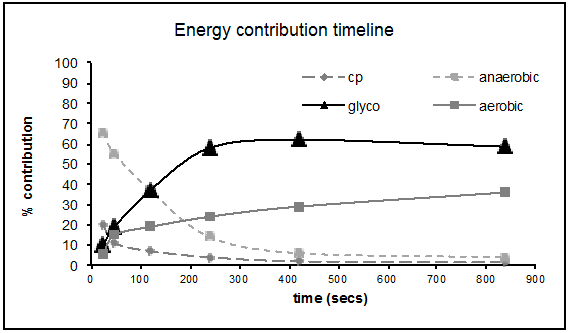
Effigy three Schematic of the proposed 4 pathway energy time line. [33], 4 energy system model and their per centum contribution (Y-centrality) to total energy output during all-out exercise of different durations (X-centrality).
Much research is based on sub maximal intensity and submaximal effort only these results are then used to extrapolate what is expected at college intensity levels. Actual measurement of globe course performance is scant as it is usually deemed to be as well difficult to achieve authentic results. We collected data on national and international level swimming performances immediately following completion of race events and used this to model the responses seen in this paper. A model of three energy pathways, CP, Anaerobic and Aerobic has been used for a number of years. It has given overall definition to the employ of energy systems but has not allowed many of the distinguishing points of exercise limitations to be explained. A new model has been proposed based upon the recruitment of muscle fibre type and the divergence in glycolysis and glycogenolysis. This adds a ivth chemical element to the pathway model. By doing this we are able to accurately predict timelines to exhaustion in performance level sporting activities.
This new model of explaining the time line of pathways at maximal effort, over both curt time periods (20 sec) and long time periods (up to 60 minutes), has proved to exist accurate in identifying what has taken identify within the race performance. Using data from this study, it has been possible to create a predictive tool that allows united states to discover the private response to high demand sporting events that matches the observations within the race. This provides an authentic tool for assessing grooming outcome and suitability to ensure that the athlete is correctly prepared for their target events at target competitions.62-72
None.
Author declares that at that place is no disharmonize of involvement.

During Activities Requiring Aerobic Endurance,
Source: https://medcraveonline.com/MOJSM/energy-systems-a-new-look-at-aerobic-metabolism-in-stressful-exercise.html
Posted by: schellertocke1967.blogspot.com
0 Response to "During Activities Requiring Aerobic Endurance"
Post a Comment