

Lewis Dot Structure For Ocl2
Oxygen Lewis dot structures with itself and other elements can be used for determining chemical bail formation. This article discusses diverse Oxygen Lewis Dot Structures diagrammatically along with their in-depth caption.
The atomic number of oxygen is eight and its electronic configuration is ii,6. This means that an oxygen atom has vi electrons in its outermost shell likewise chosen a valence shell and to attain the stable 2,8 noble gas configuration (octet) of neon it needs two more electrons. So to achieve that stability 1 oxygen atom shares its two electrons with the two electrons of another oxygen atom forming a double bond between ii oxygen atoms.

As this double bond is formed due to sharing of two-electron pairs, it is called a double covalent bond. The outermost electrons involved in sharing are called shared pairs of electrons and the outermost electrons non involved in sharing are called lone pairs of electrons. Hence a stable oxygen molecule with the formula Otwo is formed.
The easiest manner of understanding the structural representation and Lewis dot structure which works on any atom, molecule, and chemical compound is given below:
- Count the total number of valence electrons (12 electrons in the case of oxygen molecule, half dozen from each oxygen atom).
- Calculate the required electrons (co-ordinate to octet dominion it is 8 in oxygen cantlet and 16 in oxygen molecule.
- Calculate the bonding electrons (No. of Bonding electrons = Required electrons – Valence electrons, xvi -12 = 4 in the case of oxygen molecule)
- Calculate the number of nonbonding electrons (No. of not-bonding electrons = Valence electrons – Bonding electrons, 12-4 = eight in the case of oxygen molecule)
Emphasizing these four steps, then the no. of bonding electrons informs you about the presence of a double bond in the above-mentioned case. The number of nonbonding electrons indicates the presence of lone pair electrons. In the above case, there are eight lone pairs of electrons which when divided past ii gives the number of electrons per oxygen cantlet (4). Hence there are 2 lone pairs of electrons.
An interesting fact nearly the O2 molecule is that it is paramagnetic due to the presence of unpaired electrons. Though this fact cannot be explained by the Oxygen Lewis dot construction and requires a molecular orbital diagram of O2 which is quite complex. Now let u.s. discuss Oxygen Lewis Dot Structure with different elements shown as follows:
· Oxygen Lewis dot structure (Ion)
· Oxygen Lewis dot structure (Atom)
· Oxygen Lewis dot structure with Hydrogen
· Oxygen Lewis dot construction with Lithium
· Oxygen Lewis dot structure with Beryllium
· Oxygen Lewis dot structure with Carbon
· Oxygen Lewis dot structure with Fluorine (OF2)
· Oxygen Lewis dot structure with Sodium
· Oxygen Lewis dot structure with Magnesium
· Oxygen Lewis dot structure with Aluminium
· Oxygen Lewis dot construction with Silicon
· Oxygen Lewis dot structure with Chlorine (OCl2)
· Oxygen Lewis dot structure with Potassium
· Oxygen Lewis dot structure with Calcium
Oxygen Lewis dot construction (Ion)
Oxygen ion is represented equally Oii-. It has a double negative accuse attained by gaining 2 electrons. This tin can be easily explained by the Lewis dot structure. Co-ordinate to the periodic table oxygen (Atomic number=viii and electronic configuration= 2,6) belongs to the 16thursday group so the oxygen cantlet has 6 electrons in its valence shell. So to attain stability according to the octet rule information technology has to gain 2 electrons and convert into an anion instead of its elemental form. This also emphasizes that oxygen atoms tin not just share but gain electrons as well to achieve stability.

Oxygen Lewis dot structure (Atom)
The Lewis structure of the oxygen atom is relatively easier to bear witness as it does not involve any sharing or transference of electrons. The diagram of the oxygen atom shows the valence electron for the element. As oxygen atom (Atomic number = viii and electronic configuration = two,6) belong to group xvi in the periodic tabular array, information technology will be surrounded by 6 valence electrons. Merely the pairing of valence electrons around the oxygen atom is of significance. Usually, information technology has each pair of electrons on the two sides and the rest of the ii sides have unpaired electrons.

Oxygen Lewis dot structure with Hydrogen
The Lewis dot construction of hydrogen and oxygen results in the formation of water (H2O). Hydrogen cantlet (Atomic number = one and electronic configuration = 1) has one electron in its valence beat out. So information technology requires only 1 more electron to attain the stable configuration nearest to noble gas Helium. Likewise, oxygen atom (Diminutive number = 8 and electronic configuration = 2,6) is deficient of 2 electrons to attain the target octet nearest to noble gas configuration Neon. So in this case each electron of 2 hydrogen atom are mutually shared with 2 valence electrons of a unmarried oxygen atom to grade a molecule of water.
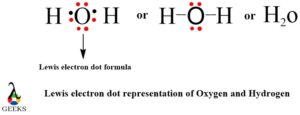
Oxygen Lewis dot structure with Lithium
The Lewis dot representation of Lithium and Oxygen shows the germination of Lithium oxide (Li2O). It can be explained visually in a improve manner. Each Lithium cantlet (Atomic number = three and electronic configuration = ii,1) loses one valence electron which is simultaneously gained by the Oxygen atom. This leads to Lithium-ion having a +ane charge each which is nearest to noble gas configuration Helium. The charges on Lithium as two [Li+] and on oxygen as [Otwo-] are due to loss of electron and gain of electron respectively.

Oxygen Lewis dot construction with Beryllium
The Lewis dot construction of Beryllium and Oxygen is relatively simple. Glucinium (Diminutive number = four and electronic configuration = ii,two) belongs to the iind group of the periodic table and has 2 valence electrons. Oxygen belongs to the 16th group of the periodic table and has 6 valence electrons. So to accomplish stability according to the octet rule Beryllium loses its 2 electrons which are gained past oxygen. As well, Beryllium changes into a Be2+ cation, and Oxygen changes into Otwo- anion thereby forming Beryllium oxide (BeO).

Oxygen Lewis dot structure with Carbon
With Carbon and Oxygen, two Lewis dot structures can be formed according to the sharing between electrons to achieve stability. These structures are Carbon dioxide (CO2) and Carbon monoxide (CO).
Emphasizing Carbon dioxide then to complete its octet unmarried carbon atom (Diminutive number = 6 and electronic configuration = 2,iv) has to bond with 2 oxygen atoms. Carbons have 4 valence electrons and require 4 more electrons and Oxygen has six valence electrons and requires two more than electrons to achieve stability. So at that place is sharing of electrons between two oxygen atoms and a carbon atom which is represented as a double covalent bond.
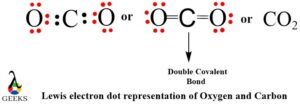
In the case of Carbon monoxide to gain stability completion of the octet is required between the unmarried carbon atom and an oxygen atom. Here in that location is sharing of ii pairs of electrons between carbon and oxygen atoms. To complete octet stability oxygen donate a pair of electron to carbon to a class coordinate bail betwixt carbon and oxygen. This results in the formation of a triple covalent bail.
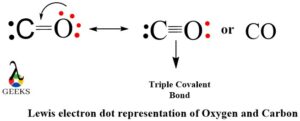
Oxygen Lewis dot structure with Fluorine (OF2)
The Lewis dot representation of OF2 is not much complex equally it involves a unmarried bond. The oxygen atom is in group sixteen with 6 valence electrons and the Fluorine atom (Atomic number = 9 and electronic configuration = 2,7) is in grouping 17 with and has 7 valence electrons. Oxygen being the to the lowest degree electronegative will be present in the centre of 2 fluorine atoms. So there volition be sharing of 2 electrons of an oxygen cantlet with a single electron of each fluorine atom on either side thereby completing the octet for each element.

Oxygen Lewis dot construction with Sodium
Sodium (Atomic number = 11 and electronic configuration = 2,8,11) belongs to the 1st group in the periodic tabular array and needs to lose ane electron to form Na+ and to proceeds stable noble gas configuration. On the other side, oxygen belongs to grouping sixteen and needs to gain ii electrons to complete the octet stability. So each sodium atom loses an electron which is gained past oxygen and results in the germination of Na2O. Here 2[Na+] and [O2-] are held past strong electrostatic forces.
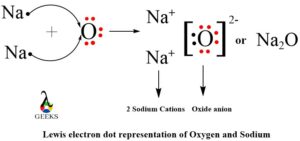
Oxygen Lewis dot structure with Magnesium
Magnesium (Atomic number = 12 and electronic configuration = 2,8,two) belong to the 2nd group in the periodic table and need to lose 2 electrons to accomplish stability. On the flip side, oxygen gains those 2 electrons to complete its octet. And so Mg2+ and O2- beingness every bit and oppositely charged get attracted to each other and form MgO which is held together by stiff electrostatic forces.

Oxygen Lewis dot structure with Aluminium
The construction formed between Aluminium (Diminutive number = 13 and electronic configuration = 2,8,three) and oxygen is aluminium oxide (Al2O3). Al2O3 is an ionic chemical compound which ways there is the transference of electrons between aluminium and oxygen. So aluminium belongs to grouping 13 in the periodic table and has 3 valence electrons and oxygen belongs to group xvi and has 6 electrons. Aluminium being less electronegative will donate its 3 electrons and oxygen being more electronegative will gain it. Hence the 2 aluminium atoms will convert into two[Al3+} cation and three oxygen atoms will catechumen into 3[O2-] anions.

Oxygen Lewis dot structure with Silicon
It results in the germination of SiO2. Silicon (Atomic number = 14 and electronic configuration = 2,8,iv) has four valence electrons and oxygen has six valence electrons. So to consummate their octet 2 atoms of oxygen volition share their electrons with a unmarried silicon atom. There will be a double covalent bond germination.

Oxygen Lewis dot structure with Chlorine (OCl2)
Chlorine (Diminutive number = 17 and electronic configuration = 2,8,7) belongs to group 17 of the periodic table and needs 1 electron to complete its stable noble gas configuration. Oxygen on the other manus belongs to group 16 and is scarce of 2 electrons to achieve the noble gas configuration. So oxygen will go the key atom and will share each electron from two chlorine atoms. This leads to the formation of OCl2 where a single covalent bond formation is there betwixt participating atoms

Oxygen Lewis dot structure with Potassium
The lewis dot structure of Potassium (Atomic number 19 and electronic configuration = two,8,viii,ane) is on the same line as that of sodium and oxygen. Potassium belongs to group 1 of the periodic table and to achieve stability it has to lose i electron. Oxygen on the other paw needs to proceeds two electrons to complete its stability. Then each potassium atom donates 1 electron to oxygen and results in ionic compound K2O and the ions are held together by potent electrostatic forces.

Oxygen Lewis dot structure with Calcium
Calcium (Diminutive number = 20 and electronic configuration = 2,viii,viii,2) loses 2 electrons to reach stability and oxygen as mentioned several times demand to gain 2 electrons to attain stability. At present due to this transference of electrons calcium and oxygen volition become reverse charged and form ionic chemical compound CaO

Oxygen Lewis dot Structure (Related FAQs)
Properties explained by Oxygen Lewis dot structure
Oxygen Lewis'due south construction is perfectly symmetric and is nonpolar. Also, nonpolar molecules are usually gases in nature hence there is not much departure in dioxygen molecule and oxygen gas
Part of outermost electrons in Oxygen Lewis dot structure
The outermost electrons are called valence electrons. They are responsible for chemic bond formation and reaction considering they are loosely bound to the nucleus. Due to less nuclear bounden force, they can hands participate in sharing and transference of electrons. On the other hand, as we move from valence electrons towards inner electrons the nuclear binding increases making information technology difficult for them to participate in whatever bail formation and reaction.
Departure in Lewis dot structure and molecular structure
Lewis Structures represent the movement and presence of electrons in a compound according to its stability cistron. It shows the number of atoms, valence electrons, and bonds readily. Nonetheless molecular shapes of compounds are influenced by diverse forces among atoms and depend on bond angles and bond lengths

Lewis Dot Structure For Ocl2,
Source: https://lambdageeks.com/oxygen-lewis-dot-structure/
Posted by: schellertocke1967.blogspot.com
0 Response to "Lewis Dot Structure For Ocl2"
Post a Comment